

Is Polyester Bad For You?
By Tyler Ball, founder of Nero · Last updated 10 November 2026
The short answer
Polyester is plastic, and it behaves like plastic against your body. It sheds fibres into the air and the wash, the catalyst it is made with comes out in sweat, and PET, the plastic it is spun from, is now measured in human blood.
What nobody can tell you yet is exactly how much harm that does. Most of what you will read on this question is either a scare or a shrug, and both skip the studies. Below is what the research shows, where it stops, and what to do about it.
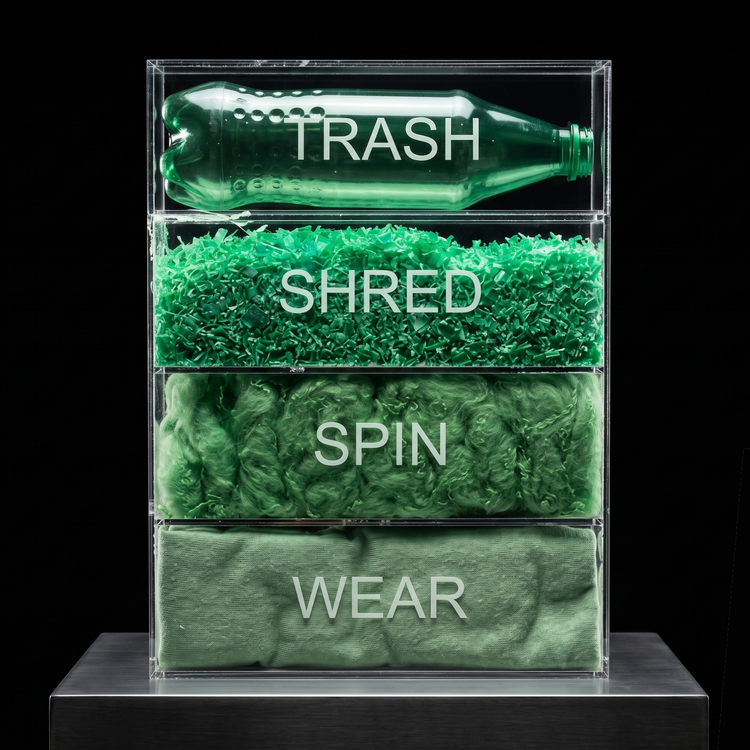
Polyester is plastic, spun into thread.
The fibre is polyethylene terephthalate, PET. The same polymer as a drinks bottle, melted and pushed through a spinneret into filaments, then knitted into the kit most gyms are full of. According to Textile Exchange's 2025 market report, polyester is 59% of all fibre produced worldwide, and 88% of it is made from fossil fuels.
Most of the rest is sold as recycled, and most recycled polyester is made from plastic bottles, not old clothes. The industry calls it "recycled." We call it what it is: plastic. A shredded bottle, spun into thread, worn against your skin.
It was patented in 1941 by two chemists at the Calico Printers' Association in Accrington, Lancashire, and reached shops in the early 1950s as a shirt you didn't have to iron. Nobody involved was thinking about an hour of hard training in it.
Polyester sheds plastic in the wash and while you wear it.
Synthetic fabric breaks down a little every time it moves. In the study that started this field, researchers at the University of Plymouth found a single 6 kg wash of synthetic clothing could release more than 700,000 microfibres. Acrylic shed the most, then polyester, then poly-cotton.
The wash is not the only route. Whole-garment testing of real polyester clothing estimated 640,000 to 1.5 million microfibres per wash, and confirmed that fibres also come off during ordinary wear. Fibres released while you move do not go down a drain. They go into the air around you.
Buying recycled makes it worse. Lab testing of 51 garments from major brands, commissioned by the campaign group Changing Markets Foundation, found recycled polyester shed about 55% more microfibres than virgin polyester, and smaller ones. It is an advocacy report, so weigh it as one.
Microfibres shed per gram of fabric, per wash
Recycled sheds about 55% more. Source: Changing Markets Foundation, 2025, NGO-commissioned lab testing.
Environment International, 2022
Plastic particles were measured in the blood of 17 of the 22 healthy adults tested.
PET, the plastic polyester is made from, was the most common, found in about half of the donors. The study shows plastic reaches the bloodstream. It does not identify where it came from. Read the study
Plastic is turning up throughout the human body.
Blood was the first. In lung tissue taken from living surgical patients, polypropylene and PET fibres were the most abundant particles identified, which points to inhaled fibres as one way in. Microplastics have been found on both sides of the human placenta.
In 2024, a University of New Mexico team found microplastics in all 23 human testes they examined, collected at autopsy. The most common polymer there was polyethylene. It is a study of presence, not cause. It shows plastic reaching the tissue that makes testosterone and sperm. It does not show what it does there.
None of these studies traces the plastic back to clothing, and you should be suspicious of anyone who says they do. What they establish is that plastic reaches human tissue, often as fibres. Polyester sheds PET fibres, the polymer found in blood and lungs, every day you wear it.
You can't control most of the plastic in your life. The fabric you sweat into for an hour a day is a choice.
The catalyst polyester is made with comes out in your sweat.
Most PET is made using antimony trioxide as a catalyst, and some of it stays in the finished fibre. A 2021 study in Regulatory Toxicology and Pharmacology puts antimony in 80 to 85% of all virgin PET. When polyester fabric was soaked in artificial sweat under standard test conditions, between 0.05% and 2% of its antimony came out, most of it on first contact.
In 2022 the World Health Organization's cancer agency classed trivalent antimony, the form used as the catalyst, as probably carcinogenic to humans. That rating is about the substance, based mainly on workplace and animal evidence. Nobody has shown that wearing polyester causes cancer, and the sweat test measured release into a liquid, not absorption through skin.
In exposure modelling of skin-contact clothing, antimony carried the highest hazard score of the trace elements measured, and for one polyester T-shirt it crossed the safety threshold. The sweat study's authors advise washing new polyester before you wear it. The simpler answer is not to wear it. More detail in antimony in polyester.

Polyester does three more things next to your skin.
It traps sweat against you.
Polyester absorbs almost no water. Sweat has nowhere to go but across the surface and back against your skin, so the layer underneath runs warm and wet. Merino absorbs moisture into the fibre core and evaporates it.
It feeds the bacteria behind gym smell.
After a spin session, a trained odour panel rated polyester shirts from 26 people significantly more malodorous than cotton. Odour-producing micrococci grew preferentially on the polyester.
It travels with plastic chemistry.
Phthalates, the plasticisers used in plastic coatings and prints, are linked with lower testosterone in US population data. That study measured exposure from every source, not clothing alone. More on polyester and testosterone.

The alternative
Active Merino Liner Short
A GOTS organic cotton shell over a built-in 17.5 micron merino liner, so there is no separate underwear and no plastic against the skin that matters most. No polyester, nylon or elastane anywhere in it.
Shop Liner Shorts
Polyester is in your kit because it costs about two dollars a metre.
Not because it performs better. Because it's better for margins. A metre of polyester costs around two dollars. Merino costs many times that. Every brand that builds its range on polyester has made that trade, and you are the one wearing it.
Very little of the research above appears on a polyester swing tag. The silence is not an accident. It is a business decision.
You don't need a final verdict to stop wearing plastic.
The research on microplastics and the body is young, and it will take years to settle. You will train hundreds more times before it does. Every one of those sessions puts plastic against warm, sweating skin, or it doesn't.
What touches the skin should come from the earth, not a refinery.
Some polyester claims outrun the evidence. Here is where it stops.
"The microplastics in your body come from your clothes."
Not proven. Food, water, packaging and dust all contribute. Clothing is the source you wear against your body every day, which makes it the easiest one to cut.
"Polyester underwear lowers sperm count."
The large human study usually quoted, 656 men in Human Reproduction, compared tight and loose underwear, not fabrics. Men in looser boxers had 25% higher sperm concentration. Fit was the variable, not fibre.
"Polyester is why testosterone is falling."
Not shown. Testosterone in young American men fell from 605 to 451 ng/dL between 1999 and 2016, and phthalate exposure is associated with lower levels. Nobody has tied either to clothing directly.
To get plastic off your body, start here
□ Replace what touches your skin longest first: underwear, liners, base layers
□ Read the composition tag, not the marketing copy. Recycled polyester is polyester
□ Check the last percentage on the tag. Elastane is a synthetic too
□ Wash any polyester you keep before you wear it, since most antimony came out on first contact in testing
Common questions
Is recycled polyester safer than virgin polyester?
No. It is the same polymer, mostly made from bottles, and 2025 lab testing found it shed about 55% more microfibres than virgin polyester.
Is polyester bad for your skin?
It holds sweat and heat against the skin instead of absorbing them, and it favours odour-producing bacteria. If your skin reacts during training, that warm, wet layer is the first suspect. More in is polyester bad for your skin.
Can you absorb microplastics through your skin from clothing?
That has not been established. The known routes into the body are breathing and swallowing, which is why the fibres polyester sheds into the air while you wear it are the part to take seriously.
Does washing new polyester help?
It reduces the antimony released on first wear, according to the sweat study. It does nothing about shedding, which carries on every wash and every wear.
What should you wear instead of polyester?
Natural fibres. Merino wool next to the skin, GOTS organic cotton for shells and underwear, Tencel lyocell for tees. None of them is plastic, so none of them sheds plastic.
The short version
Polyester is PET plastic. It sheds microfibres every wash and every wear, recycled versions shed more, and PET is the most common plastic measured in human blood. The antimony it is made with comes out in sweat in lab testing, and the WHO's cancer agency rates that form of antimony as probably carcinogenic.
Nobody has proven that wearing polyester harms you. Nobody has proven it is safe either, and the industry has every reason not to look. If you would rather not wait for the answer, take it off your skin first: underwear, liners, base layers, then everything else.