

Is Polyester Bad For Your Skin?
The short answer
It traps heat against you, gives odour bacteria a surface to colonise, and releases antimony into your sweat. Your skin is the organ dealing with all three.
Here is what each of those actually does over an hour of training, and how much of it is your fabric rather than you.

Heat is the first problem.
Polyester is dense and non-porous. It cannot absorb, so it pushes sweat to the surface and holds warmth against the skin underneath. That is what quick-drying means in practice.
Skin held warm and damp for an hour is skin with a compromised barrier. Add friction from a waistband or a liner and you have the conditions for chafe, irritation and heat rash, none of which are your fault.
Malodour after an identical session, rated by a trained panel
26 people wore identical shirts through an intense spin session. Odour-causing micrococci grew preferentially on the synthetic fibre. Source: Callewaert et al, Applied and Environmental Microbiology, 2014.
Bacteria are the second.
The smell in synthetic kit is bacterial, not chemical. Polyester gives odour-causing bacteria a surface to cling to, and washing never fully clears it. That is why the smell returns within minutes of putting a clean shirt back on.
Those same bacteria sit against your skin for the whole session. On skin already warm, damp and rubbing, that is not a neutral thing.

Your skin is not a barrier you can ignore. It is the largest organ you have, and it is in contact with plastic for an hour a day.
And then there is the chemistry.
Antimony migrates into sweat
Antimony trioxide is the catalyst used to make PET and is present in 80 to 85% of virgin polyester. Lab testing found 125 to 470 µg/g in finished fabric, a fraction of which released into artificial sweat under standard conditions.
Dyes and finishes sit on top
Polyester is chemically inert, so it will not take dye without heavy processing, high heat and a stack of auxiliary chemicals. Anti-odour treatments get added on top of that, and they wash out within a few cycles.
Microfibres come off it constantly
A single 6 kg wash releases more than 700,000 microfibres, and later work found synthetics shed during ordinary wear too, not only in the machine.
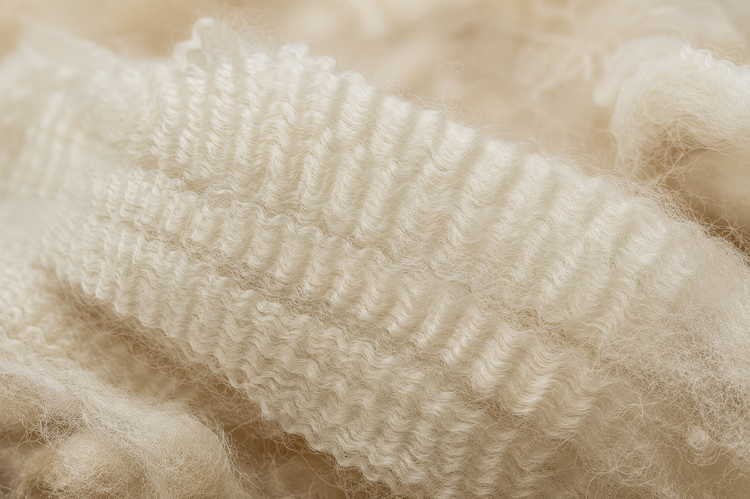
Wool is tested against skin, not just for it.
In a randomised clinical trial of 39 children with mild to moderate eczema, superfine merino worn against the skin for six weeks reduced severity compared with cotton, and reversed when they switched back.
That is superfine merino specifically. Coarse wool is a different fibre with a different effect, which is where the itchy jumper reputation comes from.
Merino also absorbs moisture into the core of the fibre rather than leaving it on your skin, and resists the bacteria that make synthetics smell.
Start with the layer touching you.
The liner and the underwear are held against skin for the entire session and they are almost always synthetic, even when the shell is not. Changing those two changes more than changing the shirt.
No polyester. No nylon. No plastic anywhere it touches you.
The short version
Polyester holds heat against your skin, gives odour bacteria somewhere to live, and releases antimony into your sweat. None of that is dramatic on any single day. All of it is happening for an hour a day, every day, for years.
If you want the fuller picture, we cover why it is used at all in this piece, and the hormone research on our testosterone page.