

Polyester vs Merino Wool: Which Performs Better?
One is spun from petroleum. One grows on a sheep. Everything else follows from that.
Here is the head to head, on the things that actually matter when you are an hour into a session.
| Polyester | Merino | |
|---|---|---|
| Moisture | Pushes it to the surface | Absorbs into the fibre, evaporates |
| Heat | Traps it against the skin | Regulates in both directions |
| Odour | Bacteria cling to the fibre | Resists build-up naturally |
| Shedding | Microplastics, every wash | None |
| Origin | Petroleum | A sheep |
| Cost per metre | About two dollars | Many times that |
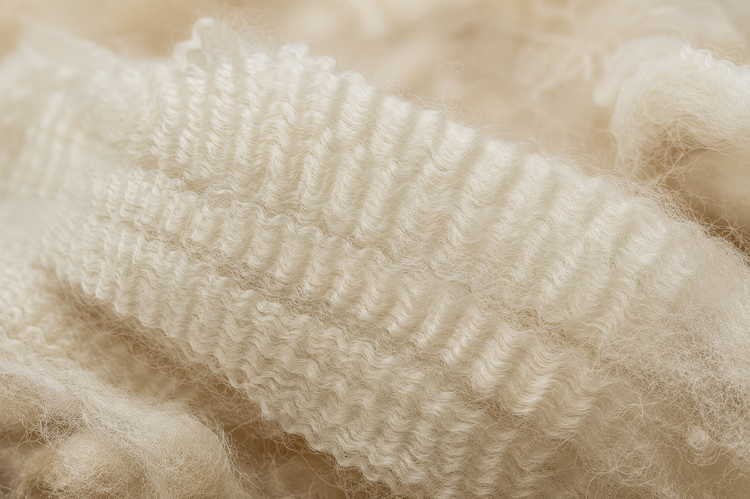
Moisture: one moves the problem, one deals with it.
Polyester cannot absorb. The fibre is hydrophobic, so sweat is pushed along the surface and out. That is what quick-drying means. The moisture leaves the fabric by sitting on you first.
Merino takes moisture into the core of the fibre and releases it as vapour. The surface against your skin stays dry while the fibre does the work internally.
Same outcome on a spec sheet. Completely different experience at minute forty.
Polyester dries fast because it refuses to hold anything. That is not a feature. That is the whole problem.
Malodour after an identical session, rated by a trained panel
26 people wore identical shirts through an intense spin session. After 28 hours, a trained odour panel rated the polyester significantly more malodorous, and odour-causing micrococci had grown preferentially on the synthetic fibre. Source: Callewaert et al, Applied and Environmental Microbiology, 2014.
Odour: the difference is bacterial.
Synthetic kit smells because odour-causing bacteria have a surface to cling to. Wash it and the smell returns within minutes of putting it back on, because the fibre itself is the problem.
Merino absorbs the compounds bacteria feed on into the fibre rather than leaving them on the surface. That is why a merino liner can be aired overnight and worn again, and a polyester one cannot.

Microfibres released per six kilogram wash load
Controlled machine-wash testing across polyester, poly-cotton and acrylic. Source: Napper and Thompson, Marine Pollution Bulletin, 2016. Natural fibres shed no plastic.
What comes off the fibre, and where it goes.
Microplastics reach human tissue
A 2024 study found microplastics in all 23 human testicular samples tested, at a mean concentration of 329 µg per gram. Polyethylene was the most prevalent polymer.
Antimony is in the polyester itself
Antimony trioxide is the catalyst used to make PET and is present in 80 to 85% of virgin polyester. Lab testing found 125 to 470 µg/g in finished fabric, a fraction of which migrated into artificial sweat.
Merino is tested against skin, not just for it
In a randomised clinical trial of 39 children, superfine merino worn against the skin reduced eczema severity compared with cotton over six weeks.
Micron count and the prickle threshold
Prickle is a mechanical response, not an allergy. It correlates with the percentage of fibres coarser than roughly 30 micron. Source: Naylor, Stanton and Speijers, Textile Research Journal, 2014.
Polyester wins on one thing.
Polyester is now 59% of all fibre made worldwide. Not because anyone tested it against wool and found it better. Because it costs about two dollars a metre and merino costs many times that.
Cheap is the entire case for it. There is nothing else.
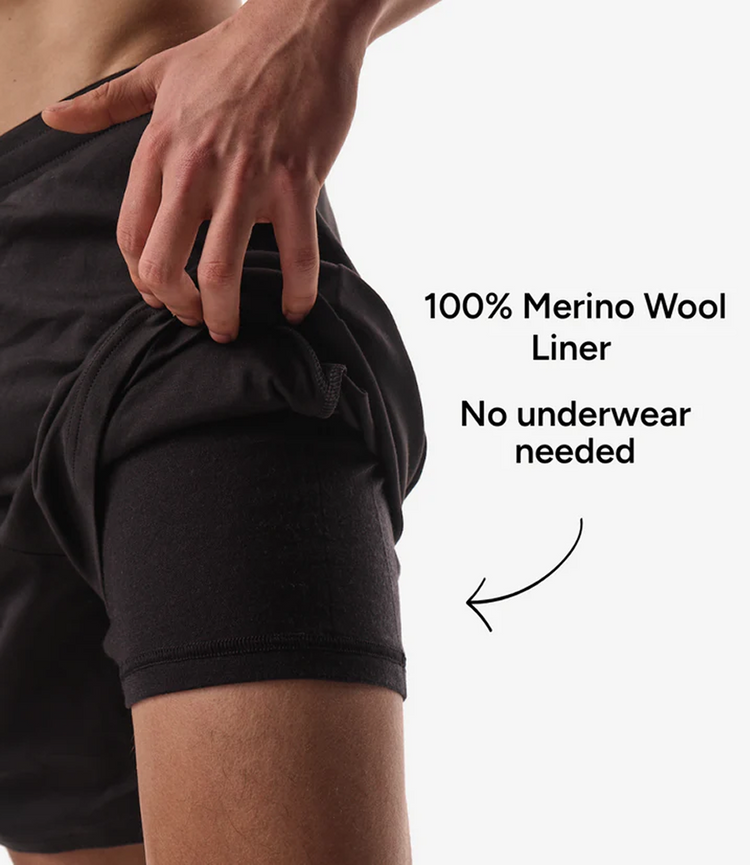
Where we put each one.
Nowhere, in the case of polyester. Two fabrics, two jobs. A 100% organic cotton shell handles the outside. A 100% merino liner at 17.5 micron sits next to skin, where it regulates temperature and resists odour.
The merino comes from RWS certified farms. The cotton is GOTS certified. Neither is the cheap option.
The research on synthetic fabric and hormones is on our page about polyester and testosterone.
The short version
Merino wins on moisture. On heat. On odour. On what comes off the fibre and ends up in you. Polyester wins on price, and only on price.
That is why 59% of the world's fibre is plastic, and it is the only reason.