

Antimony In Polyester: Should You Worry?
The short answer
Worry is the wrong word. Antimony is the catalyst most polyester is made with, it comes out of the fabric in sweat, and in 2022 it was classed as a probable carcinogen. You don't need to panic. You also don't need to wear it.
The longer answer is worth having, because it explains why a chemical most people have never heard of is sitting in most of the training kit on the market.
Estimated share of PET, the plastic polyester is made from, produced with an antimony catalyst.
Antimony is how polyester gets made.
Polyester is PET, the same plastic as a drinks bottle, spun into thread. To make PET, manufacturers link small molecules into long chains, and the reaction needs a catalyst. For decades the standard catalyst has been antimony trioxide. Estimates in the literature put the share of PET made this way at 80 to 90%.
The catalyst doesn't get used up and taken away. It stays locked in the plastic. Typical dosing is 150 to 300 ppm, and the EU's own technical report on textiles puts commercial polyester fibre at 200 to 300 ppm of antimony.
That's in the fibre of the shirt, the shorts and the liner. For a garment that sits against wet skin for an hour, the question isn't whether the antimony is there. It's how much of it comes out, and when.
The alternatives exist. The industry mostly doesn't use them.
Antimony isn't the only catalyst that works. Titanium does the job at a fraction of the dose, and germanium works too. Titanium tends to discolour the plastic. Germanium is expensive. Antimony gives a reliable, low-cost, colour-stable result, and swapping catalysts on a continuous production line is a risk nobody wants to take.
So the choice was made the way most choices in this industry are made. Not on what touches your skin. On what keeps the line running and the cost per metre down.
Typical catalyst dose in PET production, ppm
Bars drawn to the top of each range. Titanium does the same job at roughly a tenth of the dose. Source: Polymers, 2019.
Regulatory Toxicology and Pharmacology, 2021
Polyester soaked in artificial sweat at body temperature released up to 2% of its antimony, most of it in the first soak. At room temperature, significantly less came out.
Six polyester items, three of them garments, held 125 to 471 µg/g of antimony in total. This measured release into a sweat solution, not absorption through skin. Read the study
Warm sweat is what pulls it out.
Look at the conditions in that study. Artificial sweat, held at 37°C, against polyester. That's not a lab curiosity. It's the condition you create inside a polyester shirt every time you train, and the warmer the sweat, the more came out.
It leaves through the laundry too. When a researcher at the University of Plymouth analysed 70 samples of household dryer lint, antimony turned up in 8 of them and was traced back to polyester clothing.
The authors of the sweat study recommend washing new synthetic clothes before wearing them, more than once. They also say it doesn't completely solve the problem.
The cancer classification changed in 2022.
In March 2022 the International Agency for Research on Cancer classified trivalent antimony, the form in antimony trioxide, as probably carcinogenic to humans. That's Group 2A. The evidence came mainly from inhalation, in lab animals and in industrial workers.
To be precise about it: IARC grades how strong the evidence is that something can cause cancer, not how much risk a given exposure carries, and it didn't assess clothing. Nobody has shown that wearing polyester causes cancer, and we won't claim it does.
What has been modelled is skin exposure. A Spanish study of skin-contact garments estimated dermal exposure to trace elements through sweat. Antimony carried the highest hazard score of any element for adults wearing polyester, and one polyester T-shirt went over the safety threshold.
"It's locked into the plastic."
Sweat at body temperature pulls some of it out, and the first wear releases the most.
"Recycled polyester is the cleaner choice."
Bottles are made with the same catalyst. The EU Ecolabel caps antimony in polyester fibre at 260 ppm and exempts fibre made from recycled bottles.
"Just wash it first."
The researchers say wash it more than once, and that even then it doesn't fully solve it.
The only limits are the ones brands choose to meet.
Two labels put a number on antimony. The EU Ecolabel caps it at 260 ppm in the polyester fibre itself, with the recycled-bottle exemption above. OEKO-TEX STANDARD 100 caps how much can be extracted from the finished product, at 30 mg/kg. One measures what's in the fibre, the other measures what comes out, so the two numbers can't be compared directly.
Both are voluntary labels, not laws. Unless a garment carries one of them, you have no way of knowing whether anyone checked.
On the tag, look for
□ Polyester, PES, PET or recycled polyester. Different names, same plastic, same catalyst.
□ Blends. A 50/50 tee is half PET, wherever it sits against you.
□ The liner, separately from the shell. It's the part your sweat reaches first.
□ A named certificate. OEKO-TEX STANDARD 100 or MADE IN GREEN, which cap extractable antimony.
The catalyst comes with the plastic. Skip the plastic.
Natural fibre isn't made in a reactor.
Merino grows on a sheep. Organic cotton grows in a field. Tencel is spun from wood pulp in a closed-loop process. None of them is made by chaining up PET, so none of them needs the catalyst polyester is built on.
On top of that, we hold the finished garments to OEKO-TEX. STANDARD 100 caps extractable antimony at 30 mg/kg. Our merino is produced under OEKO-TEX MADE IN GREEN, which requires that test, and our Micro Tencel is STANDARD 100 certified at fibre, yarn and fabric.
You get a fibre that was never made with it, tested by someone who checks anyway.
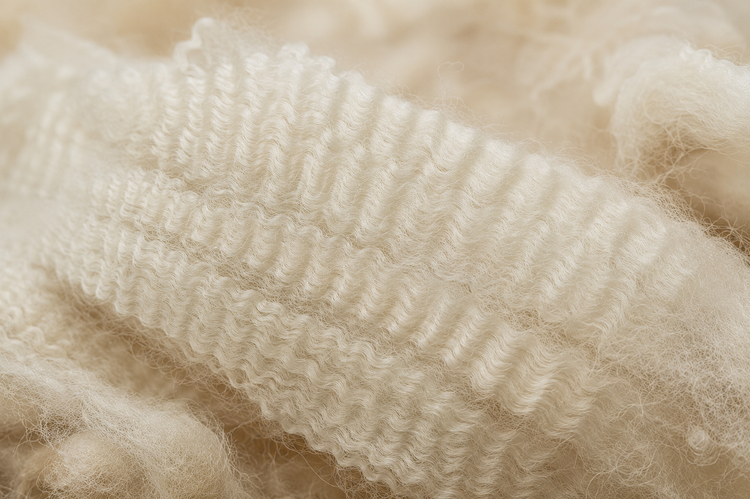
You shouldn't have to wash a catalyst out of your shirt.
The advice from the people who measured this is to launder new polyester more than once before you wear it. That's the industry's chemistry problem, handed to you as a laundry job.
Or wear something that was never made with it.
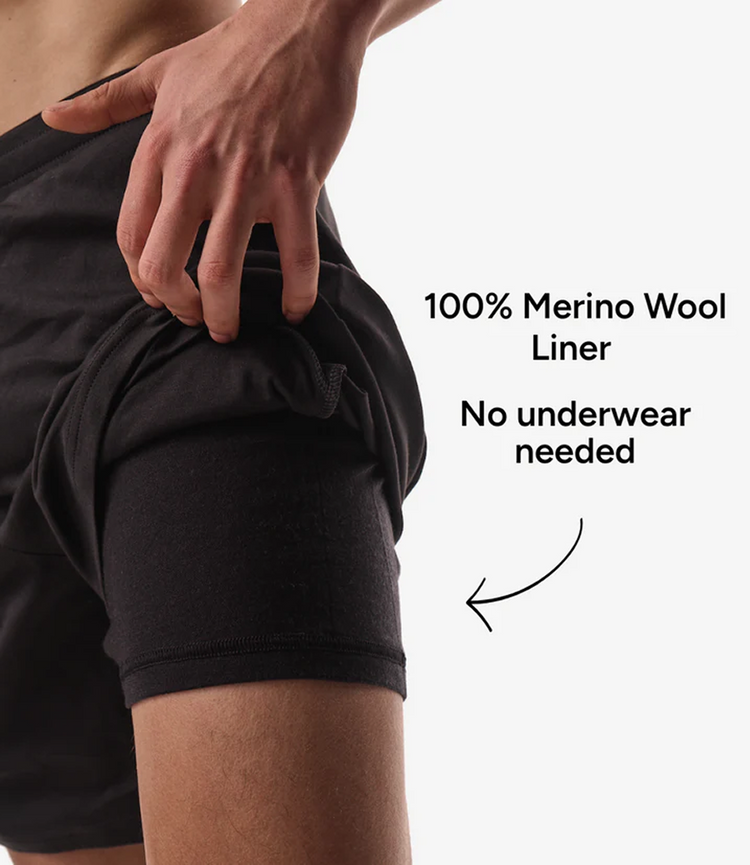
Where it matters most
Active Merino Liner Short
The liner is the layer your sweat soaks into first. Ours is 100% merino at 17.5 micron, under a GOTS organic cotton shell, with no separate underwear needed. No polyester, nylon or elastane anywhere in it.
Shop Merino Liner ShortsThe short version
Most polyester is made with an antimony catalyst, and some of it stays in the fabric. Warm sweat pulls a share of it out, most of all in the first wear, and the form of antimony involved was classed as a probable carcinogen in 2022. Nobody has shown that wearing polyester harms you. Nobody has shown it's a good idea either.
You can manage it by washing new kit twice and hoping. Or you can train in fibres that were never made with it: merino liner shorts, a Micro Tencel training tee and merino base layers for the cold.